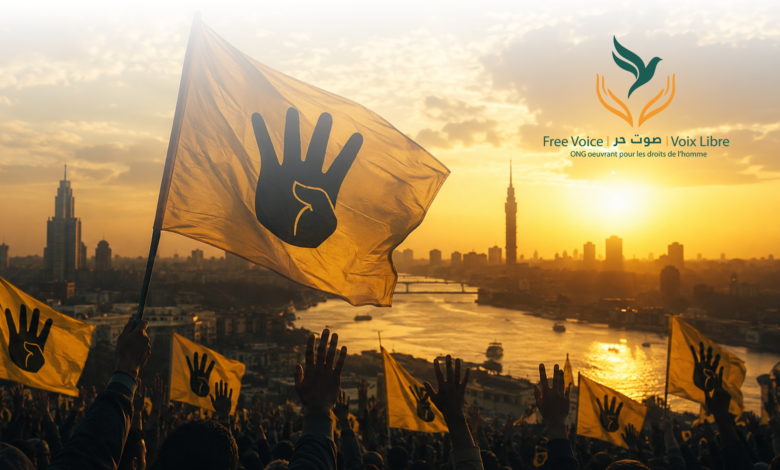
Human Rights Report on the Thirteenth Anniversary of the Rabaa Massacre 14 August 2013 – 14 August 2026
This post is also available in:
 English
Rabaa: From a Massacre in the Square to a Trial of the Global Conscience Thirteen Years After the Tragedy: A Memory That Does Not Die and a Crime That Does Not Expire
Paris, 14 August 2026
Today marks thirteen years since the Rabaa massacre, one of the bloodiest events in modern Egyptian history. On 14 August 2013, Egyptian security forces stormed the Rabaa al-Adawiya sit-in in Cairo in a large-scale operation that left hundreds dead and wounded, followed by a widespread campaign of arrests, unfair trials, and other violations.
Thirteen years have passed, yet the tragedy has not become a mere page of the past. Behind the numbers are names, faces, and families who lost their loved ones; survivors who still bear the آscars of what happened; and a collective memory that cannot be erased by the passage of time.
On this anniversary, Free Voice affirms that remembering Rabaa is not a symbolic gesture or merely a matter of placing a position on the human rights record. Rather, it is a legal, human rights, and moral duty toward the victims, and a commitment to their right to truth, justice, accountability, and reparation.
What Happened in Rabaa?
On the morning of 14 August 2013, Egyptian security forces began an operation to disperse the Rabaa al-Adawiya sit-in, which included large numbers of peaceful protesters demanding the reinstatement of the elected president, Mohamed Morsi, following his overthrow on 3 July 2013. The dispersal operation turned into one of the deadliest mass killings of protesters in modern Egyptian history.
In an extensive investigation based on interviews with witnesses and survivors, as well as an analysis of events on the ground, international organizations concluded that security forces killed at least 817 people in Rabaa within a few hours, and estimated that the death toll may have exceeded one thousand. They considered the widespread and systematic killing of protesters to potentially amount to a crime against humanity.
Estimates by international organizations and bodies may differ regarding the final number of victims, but these differences do not alter one established fact: hundreds—and perhaps more than one thousand—people lost their lives without having committed any crime during the dispersal of the two sit-ins.
The Testimony of the United Nations
Calls for investigation and accountability were not limited to non-governmental human rights organizations. The United Nations Human Rights Committee expressed concern over what it described as the “excessive use of force by Egyptian security forces” and confirmed that more than 900 anti-government protesters were killed during the dispersal of the Rabaa and al-Nahda sit-ins on 14 August 2013.
The Committee also expressed concern over the lack of accountability for those responsible for the excessive use of force. It called for those responsible to be held accountable and for victims to receive full reparation.
Despite the limited nature of this position or characterization, this UN acknowledgment remains important because it confirms, at the very least, that Rabaa is not merely a matter of conflicting political narratives, but an established and documented reality involving a grave human tragedy that occurred in Rabaa.
Judicial Prosecutions That Spared the Perpetrators and Targeted the Victims
One of the most striking and absurd consequences of this massacre is that the investigations and judicial proceedings that followed the dispersal of the Rabaa sit-in did not target the perpetrators or those responsible for the crime. Instead, they targeted the victims themselves: protesters, survivors, and the families of victims.
Throughout the following years, the Rabaa case remained associated with unjust mass convictions and unfair trials that drew widespread human rights criticism. Meanwhile, the question of accountability for members of the security forces and those who gave the orders for the mass killing remained unanswered.
Thirteen Years of Impunity
The passage of thirteen years without an independent and effective investigation into responsibility for the killings is itself part of the tragedy of the Rabaa massacre.
After thirteen years, Free Voice organization, together with international human rights organizations, reiterates that the comprehensive failure to investigate reinforces the need for a transparent and accountable international investigation capable of putting an end to the impunity associated with this horrific human tragedy. We regard the years that have followed the massacre as “a decade of shame” and an ongoing test of the world’s conscience.
Today, Free Voicie join all human rights voices calling for the truth to be revealed and for accountability, reaffirming that the case has not been closed from a human rights perspective and that the families of the victims are still waiting for justice.
When the Authorities Are Part of the Crime
One of the most important lessons imposed by the Rabaa case is that the pursuit of justice becomes futile when the authority expected to conduct the investigation is not independent of the parties implicated in the violations, but is itself a party to the crime.
Therefore, what is required is not merely the formal reopening of a case file or a closed internal investigation. What is needed is an independent, impartial, and effective UN investigation with genuine access to documents, witnesses, and evidence, and with the capacity to determine responsibility at all levels.
Responsibility, where established, must not be limited to those who carried out orders on the ground. An independent investigation should examine the entire chain of decision-making, including those who planned the operation; those who issued or approved the orders; those who exercised effective authority over the forces involved; and those who contributed to the violations, covered them up, or attempted to justify or whitewash them.
Determining responsibility must be the result of an independent investigation based on evidence and legal standards, not on predetermined political judgments. Conversely, the absence of an independent investigation cannot be used as a pretext for closing the case or granting permanent immunity to potentially responsible individuals.
Obstructing Justice Cannot Justify Forgetting the Victims
The passage of time does not turn a crime into an ordinary event. Thirteen years cannot erase the right of a family that lost a son to know the truth about what happened to him. Nor can the passage of years automatically grant immunity to anyone whose responsibility for serious violations is established.
The right to truth, justice, and redress is not bound by a fixed period of time, and the passage of time must not become a tool for escaping responsibility.
For this reason, commemorating Rabaa every year is not simply a recollection of a historical tragedy. It is a continuing reminder that delayed justice is not complete justice.
Free Voice Demands
Accordingly, on the occasion of the thirteenth anniversary of the Rabaa massacre, we at Free Voice call for:
- The opening of an independent, impartial, and prompt investigation into the killings that accompanied the dispersal of the Rabaa and al-Nahda sit-ins, in accordance with international standards for investigating deaths and serious human rights violations.
- The determination of individual and institutional responsibility for all those whose involvement is established in issuing orders, planning, carrying out, facilitating, covering up, or otherwise contributing to or enabling the violations.
- Ensuring that no official escapes accountability, regardless of rank within the security apparatus or political position, whenever responsibility is established through fair legal proceedings.
- The protection of all evidence, documents, and testimonies related to the events, and ensuring that they are not destroyed, concealed, or tampered with.
- Enabling the families of victims and survivors to access the truth and learn the full circumstances surrounding the killing of their loved ones.
- Guaranteeing victims and their families the right to reparation, redress, and compensation in accordance with international standards.
- Reviewing the mass trials and judgments issued in connection with the Rabaa events and releasing all those detained solely because of their opinions or opposition to the authorities.
- In light of the continuing absence of transparent accountability, calling upon international and UN human rights mechanisms to continue monitoring the case and to support an independent process aimed at uncovering the truth and ensuring accountability.
Conclusion: Rabaa Must Not Be Forgotten
Thirteen years later, Rabaa remains present—present in the memory of those who lost their loved ones; present in the testimonies of survivors; present in the photographs and videos documented by journalists’ cameras; present in the reports of human rights organizations; and present in the recommendations of UN bodies that continue to call for investigation and accountability.
Governments and leaders may change, and political circumstances may evolve, but the crime will not be erased, and the victims’ right to the truth does not change.
Turning the page on Rabaa without truth or accountability does not mean that the page has been closed. Rather, it means that the wound has been left open, waiting to heal, while the conscience of the world remains confronted with the test of blood.
Therefore, on the thirteenth anniversary of the Rabaa massacre, Free Voice renews its commitment to ensuring that the names of the victims remain remembered, that their families’ right to truth and redress is preserved, and that the demand for accountability for all those whose responsibility is established continues in accordance with law and justice.
Rabaa is not a page from the past to be folded away through forgetting. Rabaa is a cause of human rights, memory, and justice. Delayed justice must not be allowed to become forgotten justice.
Calling upon the international community and UN mechanisms to act today is both a humanitarian and a moral necessity—especially when national mechanisms are themselves implicated in, or complicit with, the perpetrators, and seek to conceal the truth, silence witnesses, justify the crime, whitewash those responsible, and bury every independent investigation required by international human rights obligations.
Free Voice highest objective as a human rights organization remains to ensure that impunity does not become the rule and that collective tragedies are not reduced to mere events without anyone being held responsible.