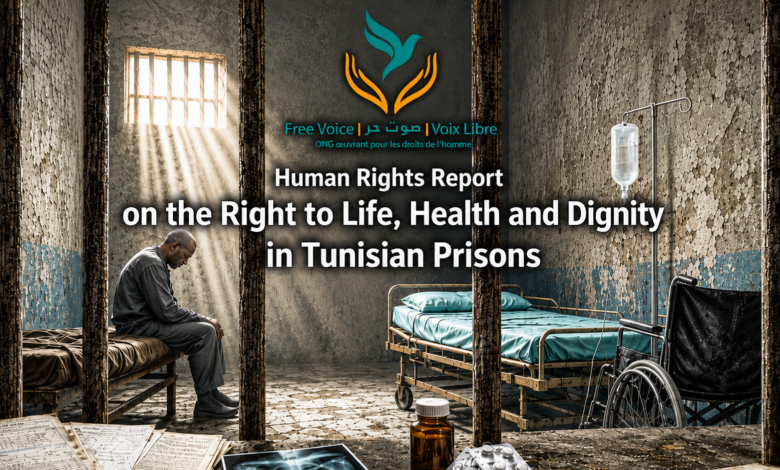
When Prison Becomes a Threat to Life No Freedom, No Treatment, No Voice: Sick Detainees in the Grip of Prison From Arbitrary Detention to Medical Abuse: Ghannouchi and Sick Detainees Face a Certain Danger Before Prison Becomes a Grave: Save the Sick Detainees
This post is also available in:
 English
Introduction
This report by Free Voice does not address the conditions of ordinary prisoners, nor does it place political detainees and prisoners of conscience in the same category as those convicted of ordinary criminal offenses.
It concerns individuals who have been detained in a highly charged political context because of their opposition to the ruling authorities and their expression of their opinions. Among them are prominent and influential opposition figures with international standing, elderly people, and individuals suffering from chronic illnesses and complex health conditions requiring precise and continuous medical care.
At the forefront are Rached Ghannouchi, Ahmed Nejib Chebbi, Habib Ellouze and Mondher Lounissi, alongside other detainees whose health conditions are giving rise to growing concern and warnings.
The seriousness of these cases must be viewed within a broader context. Human rights organisations, families and lawyers have reported deteriorating prison conditions, extreme heat, difficulties in accessing medical care, delays in administering prescribed treatment, and restrictions on visits by relatives and lawyers. Free Voice, along with other local and international organisations and bodies, has warned that these conditions could have irreversible consequences for the most vulnerable individuals.
When an 85-year-old detainee suffering from chronic illnesses is repeatedly transferred to hospital and then isolated from his family and lawyers, the issue is no longer merely one of prison conditions.
It becomes a matter of a threat to the right to life.
I. Rached Ghannouchi: Detention Described by the United Nations as Arbitrary, and Continuing Health Deterioration
Rached Ghannouchi’s case occupies a leading position in recurring human rights reports and is central to this report, not only because of his age and health condition, but also because his detention itself has been condemned by a specialized UN mechanism.
In Opinion No. 63/2025, adopted by the UN Working Group on Arbitrary Detention on 10 November 2025, the Group concluded that Rached Ghannouchi’s deprivation of liberty was arbitrary and called for his immediate release and appropriate reparation. Subsequent documentary sources confirmed that the opinion considered his detention to be linked to the exercise of his fundamental rights and called for his release.
The matter did not end there. In June 2026, the failure to implement the UN Working Group’s opinion was again raised before it following the issuance of a new sentence against Ghannouchi. Al karama also formally called on the Tunisian authorities to implement the UN opinion concerning his release and to grant him his right to compensation and reparation.
Ghannouchi is therefore not merely “a detainee whose family is campaigning for his release”.
His detention has officially been described as arbitrary by a specialized UN body, yet he remains behind bars.
II. Age and Illness
Ghannouchi is 85 years old. According to his family and legal defense team, he suffers from Parkinson’s disease and a thyroid disorder, chronic illnesses requiring regular medical monitoring and strict adherence to treatment.
More seriously, his health condition is no longer simply a chronic medical issue. During the summer of 2026, he experienced a series of health deterioration.
He reportedly fainted inside Mornaguia Prison during a severe heatwave and was subsequently transferred to hospital. His lawyers also confirmed that he was repeatedly transferred to hospital within a short period, while his defense team expressed growing concerns about his health.
These developments coincided with human rights reports describing difficult prison conditions, including stifling heat, limited access to medical care and restrictions on visits.
The question is therefore no longer:
Did Ghannouchi receive treatment when his condition worsened?
It has become:
Why is an 85-year-old man suffering from chronic illnesses, whose condition has deteriorated to the point of requiring repeated hospital transfers, then returned to prison? And is the prison to which he is returned genuinely capable of providing the care his condition requires?
III. Medical Isolation: When the Family Does Not Know What Is Happening to the Patient
One of the most serious aspects surrounding Ghannouchi’s case is his isolation from his family and lawyers.
On several occasions, his defense team and family have stated that Ghannouchi was prevented from communicating with and receiving visits from them while in hospital, and that they were not provided with sufficient information about his health condition. They further stated that, on two occasions, this isolation and the denial of visits by his lawyers and family led him to undertake hunger strikes, refusing both food and medication despite his age and fragile health.
His family has also called for independent doctors to be allowed to examine him and assess his condition.
This demand cannot be separated from the international legal context.
On 28 August 2023, the African Court on Human and Peoples’ Rights issued an order for provisional measures in Case No. 004/2023 concerning Ghannouchi and others. The measures required Tunisia to take steps to remove obstacles to communication with family members and lawyers, as well as access to doctors chosen by the persons concerned.
Court records also show that the case was subject to additional provisional measures in October 2024.
The continued restrictions on communication and access to independent doctors are therefore not simply a dispute over “visitation”.
They raise a direct question about whether the Tunisian authorities are complying with the measures issued by the African Court and with their international obligations.
IV. Withholding Medical Information
Medical confidentiality cannot become a pretext for concealing the fate of a sick detainee.
We are not calling for his medical secrets to be made public.
What is required is that:
- The detainee himself knows his health condition.
- The treating physician knows his medical history.
- The defense team receives the information necessary to protect his rights.
- The family knows the true state of his health.
When a detainee is in hospital and his family and lawyers are unable to communicate with him or obtain basic information about developments in his condition, this constitutes a flagrant violation of domestic and international law and amounts to abusive treatment of an arbitrarily detained man in his eighties whose health condition is fragile.
V. Ahmed Nejib Chebbi: A Sick Heart Behind Bars
Ahmed Nejib Chebbi’s case is no less serious.
Chebbi, one of Tunisia’s leading opposition figures, is 82 years old. A document published through UN mechanisms states that he has suffered from diabetes since 2012 and underwent quadruple coronary artery bypass surgery in 2003. It recommends special monitoring in light of his age, complications related to diabetes, asthma and other health problems, including his cardiac condition.
These are not merely historical medical facts.
Advanced age, diabetes, a significant cardiac history and the need for specialized follow-up are all factors that make any deterioration in health while in prison a matter requiring the utmost attention.
In July 2026, his family reported that he suffered a health episode inside Mornaguia Prison amid extreme heat conditions and was transferred to hospital after his condition deteriorated.
Here too, the question is not whether Chebbi “deserves special treatment”, but rather:
Can the safety of an 82-year-old man with a serious cardiac history be guaranteed in prison conditions that do not correspond to his health needs?
VI. Habib Ellouze: Chronic Illnesses and an Exhausted Body Confronting the Conditions of Detention
Habib Ellouze, now in his seventies, is likewise among the cases that warrant inclusion in a special report on elderly and sick people in prison.
The seriousness of his situation has increased with his continued detention and the issuance of new sentences against him in 2026 in political cases.
Detained since March 2023, his lawyer, Mokhtar Jomai, stated that Habib Ellouze is living in “a very seriously deteriorated state of health inside prison”. He explained that his client spent his entire period of police custody in a public hospital and that, during nearly three years of imprisonment, he suffered a series of strokes. He also suffers from high blood pressure and diabetes.
Jomai added that Ellouze’s deteriorating eyesight “has reached the point where he can no longer clearly distinguish objects and has come close to blindness”. His son confirmed that his father depends on a special medical lens that cannot be replaced by ordinary glasses and requires specialized cleaning products that are unavailable in prison. He stated that “depriving him of these necessities has led to permanent swelling in his eye that may threaten permanent loss of sight”.
He also suffers from severe pelvic pain that makes movement difficult and requires the use of a wheelchair.
In addition, he suffers from severe hearing impairment. His lawyers have said that they face difficulties communicating with him during prison visits. Even during his trial, he reportedly could not understand what was happening around him, and the court had difficulty questioning him because he could not hear the proceedings or the questions addressed to him.
The question that must be put to the de facto authorities in Tunisia is:
What danger does a man in such a state of health pose that they insist on keeping him behind bars? Have illness, old age and physical weakness become additional grounds for punishment?
And what remains of the meaning of justice when a detainee reaches the point where he can barely see, cannot hear adequately, and is unable to understand what is happening around him, yet the state continues to detain him instead of ensuring the care and dignity required by its responsibility for his life?
VII. Mondher Lounissi: Kidney Risks and Medical Monitoring
Mondher Lounissi is 59 years old, a professor specializing in nephrology and kidney transplantation, vice-president of the Ennahda Movement, and has been detained since September 2023.
He requires a creatinine test every 15 days, yet he sometimes goes an entire month without being tested. Serious concerns have been raised about the deterioration of his kidney function and the need for precise medical monitoring, requiring regular examinations, treatment and specialized follow-up.
If independent medical reports establish the existence of kidney failure, the case becomes even more serious and would require a separate, expanded section.
In July 2026, he lost the ability to speak after a four-year prison sentence was upheld, without being examined by a specialist despite the prison doctor himself confirming the need for such an examination.
VIII. Authority, Prison and Illness: Who Bears Responsibility for the Detainee’s Life?
Tunisia is not exempt from its international obligations.
When a state ratifies international human rights treaties, its obligations do not stop at the gates of its prisons.
A prisoner does not lose:
- the right to life;
- the right to health;
- human dignity;
- or the right to receive appropriate medical treatment.
Illness must not become an additional punishment to a judicial sentence.
Responsibility therefore does not consist merely of transferring a detainee to hospital after he collapses.
Responsibility begins with preventing the collapse in the first place.
It includes:
- providing medication on time;
- ensuring regular medical monitoring;
- access to specialists;
- periodic medical examinations;
- urgent responses to serious symptoms;
- providing detention conditions appropriate to the detainee’s age and health condition;
- and allowing the detainee access to an independent medical opinion.
IX. When Continued Detention Itself Becomes a Matter of Accountability
In Ghannouchi’s case in particular, his health condition cannot be separated from his legal status.
If a specialized UN mechanism has concluded that his detention is arbitrary and called for his release and reparation, his continued detention nevertheless raises a serious issue concerning the Tunisian authorities’ respect for their international obligations.
When this is combined with:
85 years old + Parkinson’s disease + thyroid disorder + repeated health deterioration + repeated hospital admissions + isolation from family and lawyers + concerns regarding access to independent doctors, continued detention cannot be treated as an ordinary procedural matter. Rather, it appears to be a blatant attempt at abusive treatment and retaliation against a political opponent and a prominent intellectual and political figure with influence both inside and outside Tunisia, exploiting illness and incapacity. It may rise to the level of a state crime that no one will be able to justify.
The same applies to other elderly detainees suffering from chronic illnesses or serious health conditions.
X. Are Prisons Becoming an Additional Punishment?
The greatest danger against which we must warn is that prison itself may become a factor in worsening illness.
If there is extreme heat, poor ventilation, delays in care, difficulty accessing medication or doctors, and restrictions on visits and communication, these conditions do not affect all prisoners equally.
They affect most severely:
- elderly people;
- heart patients;
- people with diabetes;
- Parkinson’s patients;
- people suffering from kidney disease;
- and anyone dependent on regular treatment or precise medical monitoring.
Keeping such individuals in conditions unsuitable for their health can therefore turn deprivation of liberty into an additional health punishment that was never imposed by any court.
XI. Responsibility of the Tunisian Authorities
The Tunisian authorities bear full responsibility for the safety of the people they detain.
This responsibility cannot be transferred to:
- families;
- lawyers;
- human rights organizations;
- or doctors outside the prison system.
A person who is under the control of the state has his or her life and safety placed in the state’s care.
We therefore hold the Tunisian authorities responsible for:
- Ensuring appropriate and continuous medical treatment.
- Preventing any foreseeable or avoidable deterioration in health.
- Guaranteeing access to independent doctors upon request.
- Enabling detainees to communicate with their families and lawyers in accordance with the law.
- Respecting measures and decisions issued by international judicial and human rights bodies.
- Reviewing the continued detention of a detainee when his or her health condition is incompatible with prison conditions.
Urgent Demands
Based on the foregoing, Free Voice calls for:
1. The Immediate Release of Rached Ghannouchi
In implementation of Opinion No. 63/2025 issued by the UN Working Group on Arbitrary Detention, and for him to receive reparation and compensation as determined by the opinion.
2. An End to Isolation
Ghannouchi and other sick detainees must be allowed regular communication with their families and lawyers, and isolation must not be used as a means of pressure or an additional punishment.
3. Permission for Independent Doctors
The measures issued by the African Court requiring the removal of obstacles to access to doctors chosen by detainees must be implemented, and Tunisia’s compliance with these measures must be monitored.
4. Independent Medical Assessments
A comprehensive and independent medical examination must be carried out for Ghannouchi, Chebbi, Ellouze and Lounissi, as well as for every political detainee suffering from a chronic illness or serious health condition.
5. Release or Alternatives to Detention
Whenever an independent medical report establishes that continued imprisonment poses a threat to the detainee’s life or that the required care cannot be provided in prison.
6. An Independent Investigation
Into every allegation concerning the denial of medical treatment, delays in transferring detainees to hospital, the prevention of access to independent doctors, or the withholding of essential health information.
7. Transparent Disclosure of Essential Information
This does not mean publishing medical secrets. Rather, families and defence teams must be provided with the necessary information concerning the detainee’s health condition and treatment, particularly in critical cases.
Prison Is Not a Death Sentence
The gravest thing that can happen in the case of sick political detainees is for old age and illness to become undeclared forms of punishment; for their advancing years to become another arena of punishment; and for prison to become a grave.
A man may enter prison because of a political case or because of his opposition to those in power, and then find himself confronting illness, extreme heat, isolation and inadequate care. This cannot be treated as a natural consequence of imprisonment.
In the case of Rached Ghannouchi, the facts accumulate in a way that does not permit the danger to be minimized:
A detention described by the United Nations as arbitrary; a UN call for his release and reparation; measures by the African Court concerning communication with his family, lawyers and doctors; the age of 85; chronic illnesses; deteriorating health; repeated hospital admissions; and subsequent isolation from his family and legal defense.
The combination of these factors makes his continued detention a responsibility from which the Tunisian authorities cannot evade.
The state does not need to wait for another tragedy before acting.
The right to life does not begin after death. The right to treatment does not begin after collapse. And responsibility for a prisoner does not end when the cell door closes.
We hold the Tunisian authorities fully responsible for protecting the lives and safety of political detainees and prisoners of conscience, and for any harm resulting from neglect, denial of care, inhumane detention conditions or the imposition of isolation on a prisoner.
If the authorities continue to ignore warnings and international decisions, and continue to keep sick and elderly people behind bars despite the health risks, they will not only endanger their health but will deepen their responsibility for every consequence resulting from that detention.
Prison is not a death sentence.
Illness is not a crime.
Old age is not a justification for abuse.
Depriving a person of liberty does not give the state the right to endanger that person’s life.
Freedom and dignity for all prisoners of conscience.